
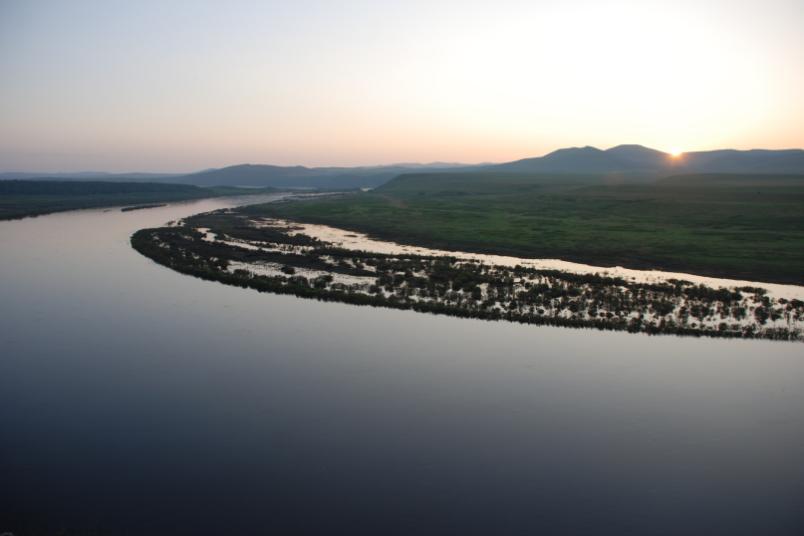
The Amur flows across over 2,000 kilometers of the border between Russia and China.
History
How the Chinese-Russian Border Has Changed
For historian and Eastern Europe expert Sören Urbansky, China and Russia share one of the most contrast-rich borders in the world. The researcher from Bochum has taken a detailed look at its history.
2,000 kilometers of the Chinese-Russian border is formed by the Amur River. Bridges have only connected the two countries since 2022. “Above all, they are a symbol of rapprochement,” says Professor Sören Urbansky. The historian and Eastern Europe expert from Ruhr University Bochum, Germany, has examined the history of this particular border and reveals how it has developed politically, economically, and in the minds of the people over the centuries. The Ruhr University Bochum science magazine Rubin reports on Urbansky’s work, which he has published both as a popular science book and as a monograph.
How the border between China and Russia was established
Urbansky has already spent a lot of time in Russia and China, and has crossed the border. “This is where two entirely different societies meet. For me, the border between China and Russia is the most contrast-rich in the world,” he says. However, these contrasts were not always quite so stark.
China and Russia have maintained relations for 400 years. The first contact was made in the early 17th century when Siberian Cossacks made their way to Beijing with reconnaissance caravans. The two empires formed a pact in 1689 in which they defined the course of the border. However, the border only began to be truly monitored in the late 19th century when a railway line was constructed and the customs border shifted to the national border. A firm border was ultimately established between the countries as a result of the geopolitical conflicts of the 20th century.
The resettlement campaign and the end of the nomadic peoples
“Up until 100 years ago, many Indigenous peoples who saw themselves as neither Russian nor Chinese lived in the border region,” Urbansky explains. “These nomadic lifeways were destroyed by the conflicts of the 20th century.”
A conflict flared up between the two countries in the late 1950s. It was initially ideological in nature: The Soviet Union settled many thousands of people from other parts of the country in the border area, and China followed suit. “The people living on either side of the border had no memories whatsoever of what it was like when the border was open,” says Urbansky. “They had no point of reference for the people on the other side, so it was much easier to cast them as the enemy.”
A border, the historian explains, must be enforced not only militarily, economically, and through political regulations, but also in the hearts and minds of the people.
Detailed article in the science magazine Rubin
Original publications