
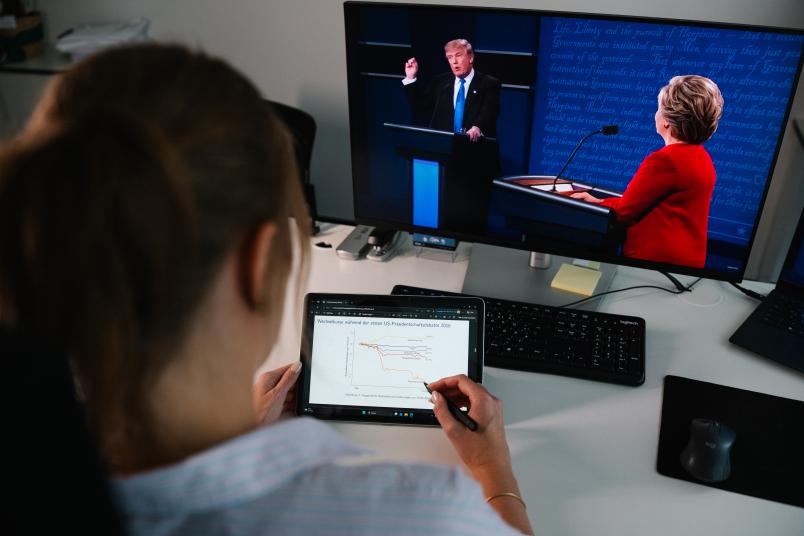
For their study, the researchers viewed all US presidential debates from 1996 to 2016 and identified how political developments in one country are carried over to other countries via financial markets.
Economics
Exchange Rates React Immediately to the Threat of Tariffs
When politicians threaten to impose tariffs, exchange rates react instantly. However, some countries are much more susceptible to such shocks.
Exchange rates are more than just abstract numbers. They determine the value of a Mexican peso, the cost of a German car in the USA, and whether an Argentinian farmer can repay his debts. Jantke de Boer, Junior Professor of International Monetary Macroeconomics at Ruhr University Bochum, has examined how expectations of future protectionist measures influence exchange rates. “Financial markets do not wait for a political decision to be implemented. They try to anticipate future developments. If it seems more likely that the USA will impose higher tariffs in the future, this can immediately be reflected in the exchange rates,” she explains. Several emerging countries are particularly negatively impacted by this; their currencies devaluate stronger than others. Ruhr University Bochum’s science magazine Rubin provides a detailed article on the findings.
US presidential debates as catalysts
In her studies, de Boer analyzed how the announcements of protectionist measures in US presidential debates affect exchange rates. To do so, the economist used the live broadcasts of US presidential debates from past years, which were always aired between 9:00 and 10:30 p.m. (East Coast Time). Other market-relevant news can be ruled out within this short time window because the major stock exchanges are closed. Parallel to this, de Boer evaluated data from prediction markets in which people bet on the outcome of the election. “The betting odds show in real time how the assessment of a candidate’s protectionist stance changes during the debate, and at the same time we can see how the foreign exchange market reacts to this,” says de Boer.
Not all countries are equally affected
Countries with close trade relations with the USA are especially strongly impacted. “The more heavily a country exports to the USA, the stronger its currency reacts,” says de Boer. One example: Mexico, which is highly dependent on exports into the USA, sees the value of the peso fall in response to protectionist announcements. This makes imports from the USA more expensive, such as machinery for the nation’s industry.
The study also shows that many emerging countries are more susceptible to such shocks. However, it became clear during de Boer’s analysis that some of these nations are especially vulnerable, and others are much more resistant. “A liquid financial market such as Brazil’s can better cushion capital outflows, and foreign exchange reserves enable central banks to support their currency,” she explains. De Boer’s research demonstrates how closely economics and policy are intertwined: Protectionist measures may provide benefits in the short term, but eventually lead to trade conflicts and higher prices.
Detailed article in the science magazine Rubin