
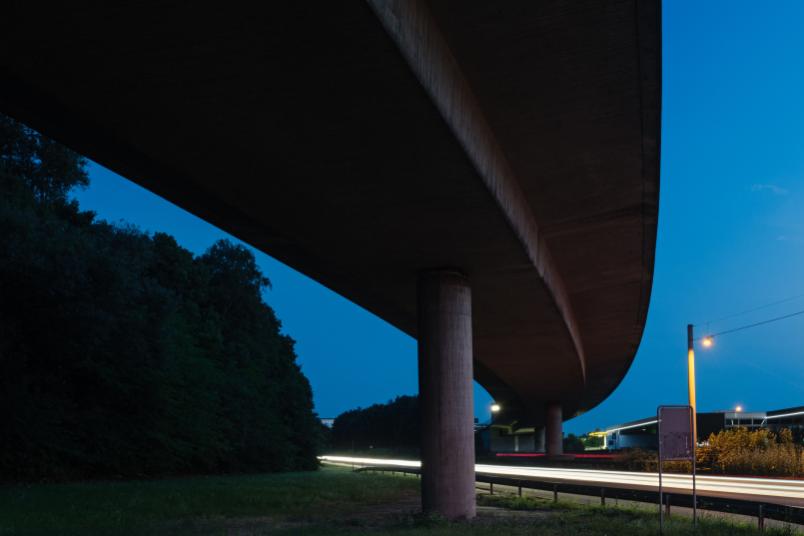
Many bridges in Germany are slowly reaching the end of their planned service life. This makes it all the more important to regularly inspect them.
Bridges
Autonomous Drones Detect Cracks in Concrete Bridges
Bridge inspections are costly and work-intensive. An autonomous drone could make this work easier for inspectors in the future, and discover cracks that cannot otherwise be seen.
A research team at Ruhr University Bochum is developing an autonomous flying drone that detects cracks in concrete bridges. The drone is intended to make costly, work-intensive bridge inspections more efficient, safe, and affordable. It is being developed by David Müller and Dr. Raphael Dyrska from the Department of Automatic Control and Systems Theory, alongside Patrick Herbers from the Department of Civil Engineering and Dr. Marcel Neuhausen from the Department of Artificial Intelligence and Formal Methods. Rubin, the science magazine of Ruhr University Bochum, reports on the project.
Many bridges were not built to withstand modern traffic
Thousands of bridges have to be inspected every year in Germany, many of which were constructed between the 1960s and the 1980s. Heat, frost, environmental factors, and increasing traffic place strain on the structures. “Inspectors normally work on site with a clipboard and a camera. This approach is demanding and prone to error,“ explains Herbers. To make matters worse, cracks in concrete are often as thin as a hair and are difficult to identify from a distance.
The drone being developed in Bochum solves this problem: It is small enough to fly into the narrow box girders of many bridges and uses AI to scan the walls for cracks. “Our drone plans its route itself and saves its findings directly on an SD card,” says Dyrska. Thanks to SLAM (Simultaneous Localization and Mapping), it can also find its way in dark, winding hollow spaces.
The next steps
The drone is currently being tested in the flight laboratory—operated by the Chair of Automatic Control and Systems Theory—at the Center for Engineering Smart Product-Service Systems (ZESS) at Ruhr University Bochum. The next goal is to use the drone on a real bridge. “We want to demonstrate that our drone not only works in laboratory settings, but also in practice,” says Neuhausen. It is supposed to support human inspectors, not replace them. The drone marks critical areas and collects data while humans perform the final assessment.
The researchers are convinced that their innovation will drive the digitalization of structural inspections. “The number of bridge inspectors is decreasing, the demands are growing, and the bridges aren’t getting any younger,” says Müller. “Our drone can make inspections safer, faster, and more affordable.”
Detailed article in the science magazine Rubin